Posted on 10 Mar 2026
The war that began in the Middle East two weeks ago with the military strikes by the US and Israel on Iran and which seems set to escalate into a much wider conflict is being watched with some concern by Chinese steelmakers, especially those exporting hot rolled coils (HRC).
Not only could direct shipping volumes be affected as sales to the region shrink but the Chinese mills will struggle to find new overseas buyers of equal importance to those in the region currently. Even worse, domestic HRC prices could decline because domestic customers will know the steelmakers must either cut production – which they will be loathed to do – or discount heavily to place their coil at home.
A crucial market under attack
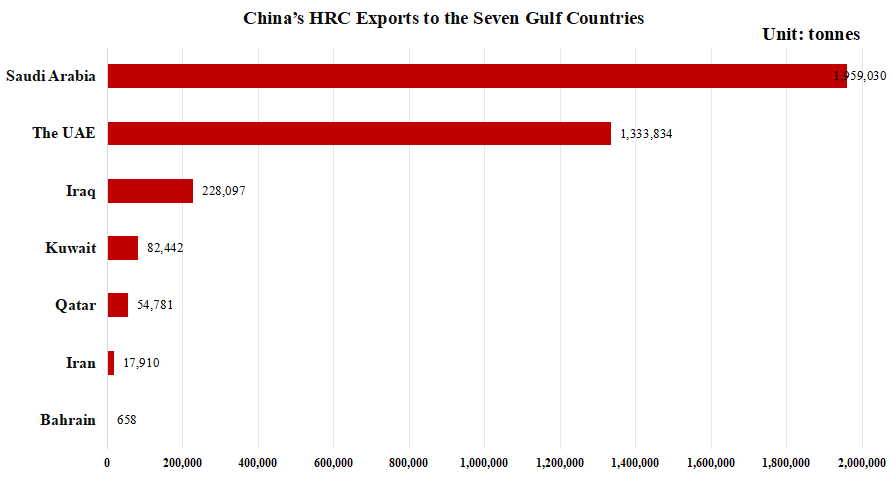
During last year, China's exports of HRC globally reached 21.5 million tonnes, representing about 18% of total Chinese steel exports worldwide, according to data from China's General Administration of Customs (GACC). Although the total HRC tonnage exported declined by 21.5% from 2024, the volume to the seven Gulf countries embroiled in the conflict – Saudi Arabia, the UAE, Iraq, Kuwait, Qatar, Iran and Bahrain – accounted by 17% of total. This was largely unchanged from 16.9% in 2024 and makes the region a crucial market for Chinese hot coil.
Out of the top 15 destinations for Chinese HRC exports last year, Saudi Arabia and the United Arab Emirates were the second and sixth largest customers respectively, as the table below shows.
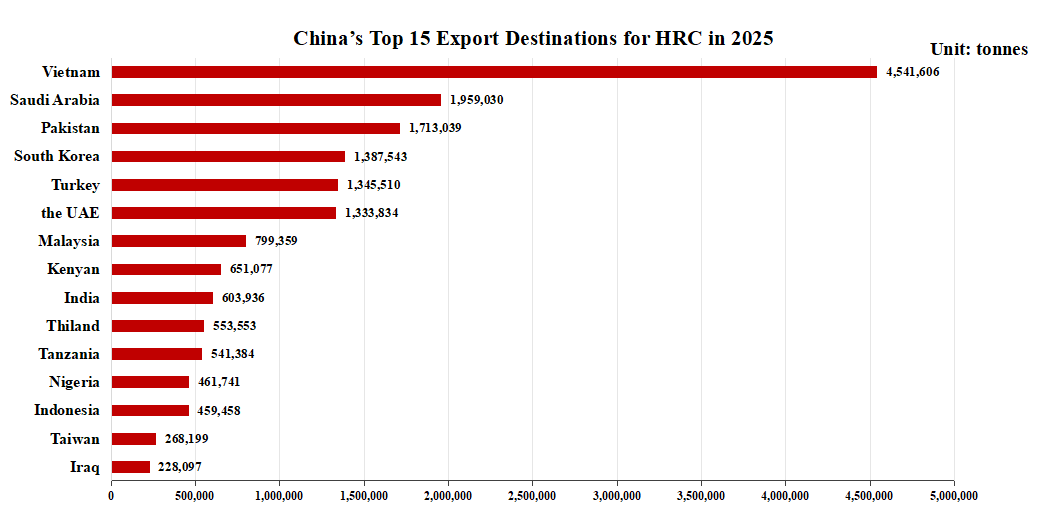
Moreover, within the top 15, three are already being deeply impacted by the conflict – namely, Saudi Arabia, the UAE and Iraq – while another three, Kuwait, Qatar and Bahrain, are quickly being dragged into the maelstrom.
True, total Chinese HRC exports to these six countries, together with those to Iran, reached only 3.68 million tonnes last year – which was lower by 20.6% from 2024 – but that tonnage was nonetheless crucial for Chinese hot coil exporters. The volume was also larger than that of other Asian rivals such as Japan and South Korea.
Interestingly, the Mid East countries at the center of the conflict – Israel and Iran – were not major buyers of Chinese HRC last year. China exported 31,238 tonnes of HRC to Israel last year, higher by just 1.3% on year, while those to Iran amounted to 17,910 tonnes, down by a whopping 62% from 2024, the GACC data show.
Chinese coils suffer the most
Despite that 21% decline in Chinese hot coils headed to the seven Gulf countries last year, the country's shippers are justified in being concerned about the trade.
Recent Japanese data show that HRC imported by the seven countries above, plus Oman and Turkey last year, totalled 6.44 million tonnes from the seven major HRC suppliers in Asia, namely Japan, China, South Korea, Taiwan, India, Indonesia, and Vietnam. Among the 6.44 million tonnes the nine countries imported from these Asian shippers, China supplied a huge 71%, followed by Japan (15%), South Korea (7%), India (4%) and Taiwan (3%), all of which were roughly at the same level. Exports to the region from Indonesia and Vietnam were nearly zero.
Its prominence makes China especially susceptible to the potential impacts of the war.
Business under pressure
According to Mysteel's assessment, import prices of SS400 3mm HRC in Dubai experienced a volatile week last week, dropping by $5/t on day to $495/t CFR Dubai on March 4 and remaining flat for two days before rising again by $10/t to $505/t by March 9. Perhaps unsurprisingly, Mysteel learnt that there were no new offers from China for HRC there during the past week.
Meanwhile, export prices of SS400 3mm HRC at North China's Tianjin port on March 6 was also largely steady on week, dipping by only $1/t to sit at $467/t as of the same day, Mysteel's other assessment shows.
Nevertheless, as the war drags on, China's makers of hot coils will be watching for signs of damage in their home market as well. Were they suffer from a loss of valuable Middle East business, they would not only have to seek new alternative markets but to also improve the added value of their products, Mysteel Global notes, a task that might lead to the accelerated restructuring of the country's flat steel export market, especially hot coil.
Source:Mysteel Global