Posted on 23 Jan 2026
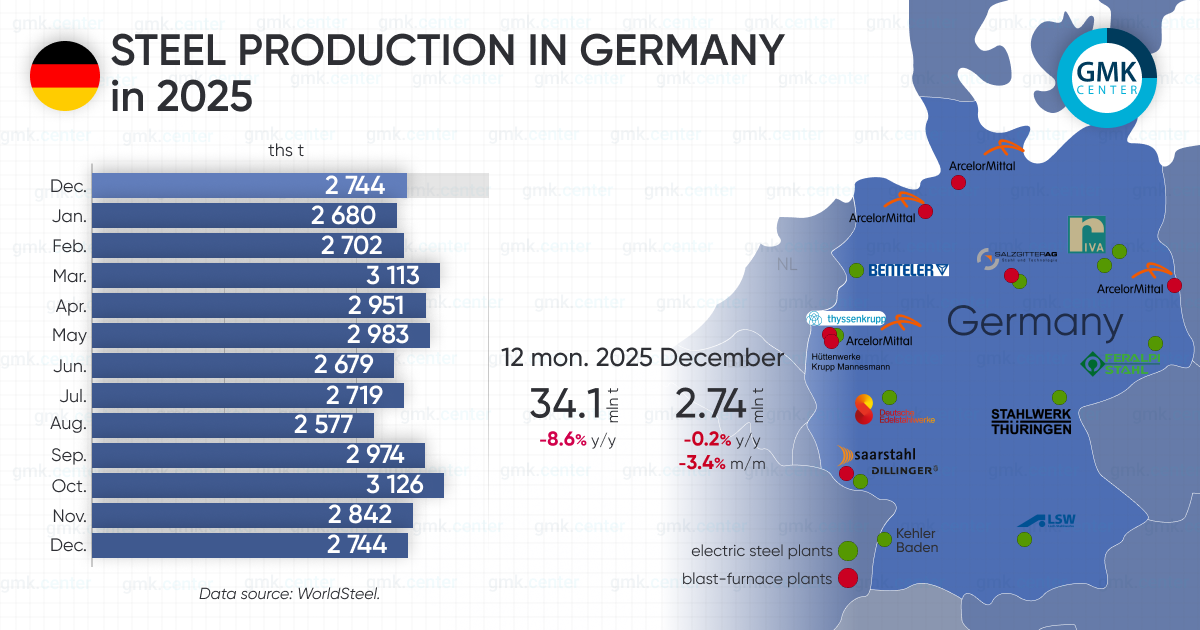
In 2025, German steel companies reduced steel production by 8.6% compared to 2024, to 34.09 million tons. This is according to data from the German Steel Industry Association WV Stahl.
Last year, 23.64 million tons of steel were produced in oxygen converters (-10.7% year-on-year), and 10.44 million tons in electric arc furnaces (-3.5% year-on-year).
Pig iron production decreased by 10.1% year-on-year over 12 months, to 21.87 million tons. Rolled steel production decreased by 5.5% year-on-year – to 29.76 million tons.
In December 2025, the German steel industry reduced steel production by 0.2% y/y and 3.4% m/m – to 2.74 million tons. Production volumes are decreasing for the 12th consecutive month in annual comparison.
Steel production in oxygen converters amounted to 2.21 million tons, which is 0.9% less y/y and 16.5% more m/m, and in electric arc furnaces – 531 thousand tons (+2.7% y/y; -43.7% m/m).
German pig iron production in December decreased by 3.1% compared to December 2024 and increased by 6.1% compared to November – to 1.98 million tonnes. Hot-rolled steel production increased by 8.3% y/y and fell by 9.7% m/m – to 2.3 million tonnes.
The German steel industry suffered a significant decline in 2025. Crude steel production fell to one of its lowest levels in history. Capacity utilization fell below 70%, which is a critical level for an energy-intensive industry and indicates that recessionary conditions persist.
Domestic demand also remained weak. According to preliminary estimates, steel consumption in 2025 was around 30 million tonnes, which is below the average level of recent years. At the same time, import pressure increased – now every third tonne of steel in the EU comes from countries outside the EU, against the backdrop of global overcapacity and heightened trade risks.
Kerstin Maria Rippel, CEO of the Wirtschaftsvereinigung Stahl, stressed that the combination of weak demand, high energy costs and growing imports was undermining the competitiveness of the industry.
“2026 should be the year of preserving the industrial base and the rapid implementation of the already announced political decisions,” she said.
The key conditions for stabilization remain the introduction of effective EU safeguard instruments, reducing electricity prices for industry, and forming sales markets for EU-produced low-carbon steel.
As GMK Center reported, Germany is among the ten largest steel producers in the world according to World Steel. According to the results of 2024, the country increased its steel output by 5.2% compared to 2023, to 37.23 million tons. Pig iron smelting for the year amounted to 24.33 million tons (+2.9% y/y), hot-rolled steel production – 31.61 million tons (+3% y/y).
Despite the growth in steel production, production volumes remained below the 40 million tons mark for the third consecutive year, which corresponds to the level of recession.
Source:GMK Center