Posted on 09 Dec 2025
China’s stubborn steel overcapacity won’t be easy to fix because the industry is so deeply intertwined with the country’s broader economy, according to the head of the World Steel Association.
“Just closing a steel company has a big knock-on effect in the rest of the domestic economy,” said Edwin Basson, director general of the organisation that represents steelmakers worldwide. “There’s no short-term practical solution,” he told Bloomberg News.
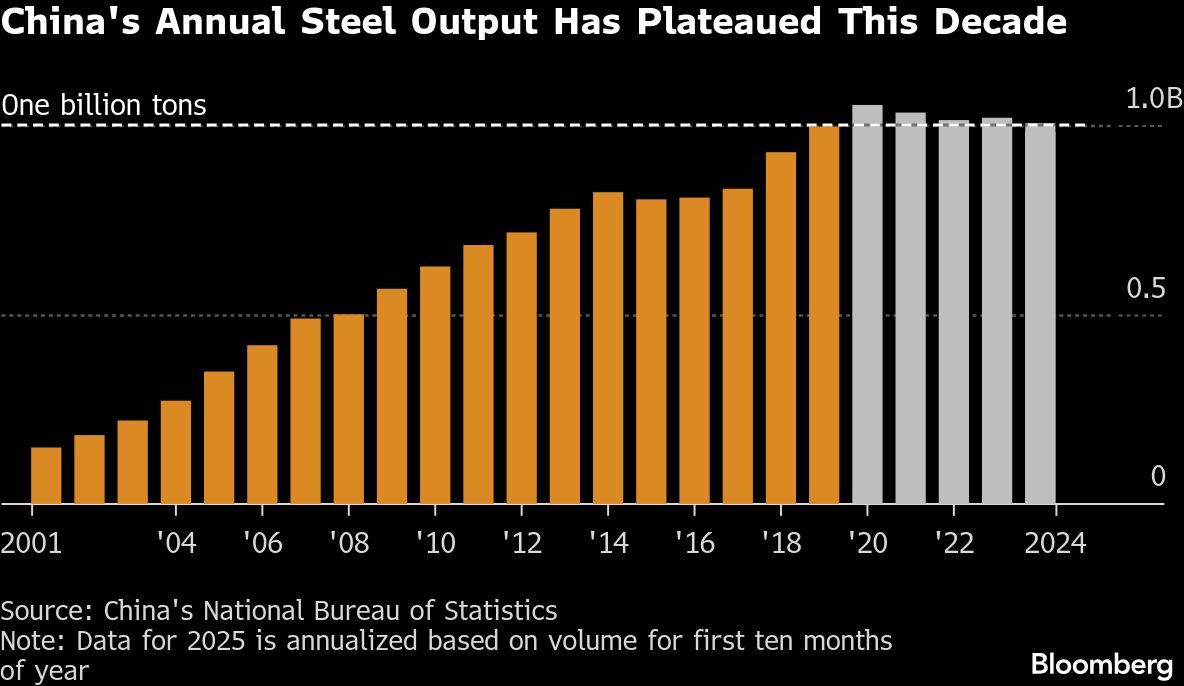
China’s one-billion-tonne-a-year steel sector is grappling with excess capacity after years of rapid expansion for a level of demand that no longer exists. A years-long slump in the country’s property market has weakened demand for steel products, creating a surplus that increasingly is being pushed into global markets at low prices. This in turn has pressured producers in other nations, escalating trade tensions.
Steel was one of the first products targeted by US President Donald Trump when he introduced a raft of import tariffs earlier this year, and many countries, including Vietnam, have slapped anti-dumping duties on China. Such trade barriers are unwinding two decades of relative openness in the global steel business.
“This open market we’ve been enjoying from 2000 to about 2020 is disappearing,” Basson said. “This ability for material to flow between continents is an important subject for the industry.”
Worldsteel expects Chinese steel demand to fall 2% in 2025 and another 1% in 2026, extending a downturn that has pushed producers to ship huge volumes abroad despite rising protectionist barriers.
Exports of steel are on track for a record in 2025, with year-to-date volumes already well above 100 million tonnes for the first eleven months, according to trade data released Monday (Dec 8). Broader export growth pushed the nation’s trade surplus beyond US$1 trillion (RM4.11 trillion) for the first time.
Iron ore futures in Singapore fell on Monday, dropping 0.9% to US$102.45 a tonne by 12.10pm local time (same time as Malaysia).
Trade will not be the only casualty of a more fragmented global steel industry, a second Worldsteel official said. Cleaning up a sector responsible for roughly 8% of global carbon dioxide emissions requires unprecedented cooperation — something that is harder to achieve as markets split, said Rizwan Janjua, the association’s head of technology.
Major breakthroughs in decarbonisation will be achieved only if countries align their efforts, he said, adding that – while the technology exists to cut emissions – energy availability and policy coordination remain significant bottlenecks for the industry. “Unless everybody’s talking to each other, everybody will try to optimise their own thing,” he said.
Source:The Edge